


At the Research Station, the outdoor cauliflower harvest continues almost all year round. The last autumn cauliflower was harvested on 18 January 2026. The very late varieties Marseille (Sakata), Leocen (Syngenta) and Newlyn (Bejo) produced a good quality crop.
Less than a month later, on 20 February, the first winter harvest took place, featuring the very early variety Paciano (Bejo). Due to night frosts on 14 and 15 February, the quality was somewhat variable, with loose flower buds and slight frost damage.
At the harvest in late February, SV5697AC (Seminis) confirmed last year’s excellent results. For the harvest in early March, Folder (Hazera-Clause) and Bilbao (Bejo) were the best varieties. In the harvest at the end of February, SV5697AC (Seminis) confirmed last year’s excellent results. A week later, Mengwenn (Hazera-Clause), Marcastle (Syngenta) and, in particular, Parotis (Hazera-Vilmorin) were of a very high quality.
Just like last year, there is a period when there is too little cauliflower to harvest from these varieties and the well-known Balak (Bejo) and Marcher (Syngenta) varieties, from which we have harvested virtually nothing to date.
The new Syngenta varieties SGC5109 and, in particular, SGC5819 appear to be very promising for bridging this gap. Among the winter romanesco varieties, Colloseo displays the finest characteristics.
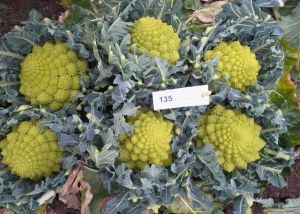
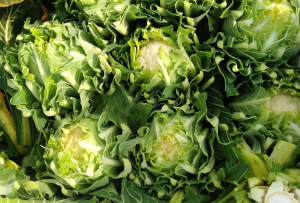
Photo on the left: Colloseo Romanesco | Photo on the right: SGC5819
