


Water management is becoming easier
From the start of March, a number of changes have been made to the Exemptions Decree. This means that certain activities no longer require a permit. A significant step forward has been taken in the area of water management. The most important change is that weirs in agricultural areas no longer require a permit; only the consent of the watercourse manager is needed. You may therefore install a weir on your own canal, which you manage yourself. A weir makes it very easy to store water and help replenish groundwater following a drought. They are certainly worth installing. You can receive VLIF support for the purchase and installation.
The conversion of an existing drainage system to a water-level-controlled drainage system is also exempt from planning permission, provided that the drainage system complies with the regulations. Furthermore, a water storage facility of up to 200m³ may be installed without planning permission at a distance of up to 50m from buildings. The conditions are that the storage facility must not come into contact with groundwater and that its walls must be covered with vegetation or integrated into the landscape. You may also construct a filling or rinsing area for your spraying equipment of up to 150 m², situated no more than 30 metres from your buildings. You must collect residual and rinse water; rainwater must infiltrate locally; and you must not provide for any overflow into the sewerage system or surface water. The weirs, water storage facilities and filling areas are only exempt if there is no designated archaeological zone.
Don’t forget your protective strips
Distance rules for fertiliser application and the use of plant protection products were already in place along watercourses. Since this year, these strips have been designated as ‘protection strips’ along VHA watercourses. They are 3 metres wide as standard, and are increased to 5 metres for nitrate-sensitive crops in area types 2 and 3. They are also 5 metres wide in SBZ-H and green zones. In addition to the existing rules on fertiliser and pesticide-free zones, the following new provisions, amongst others, apply:
- No cultivation permitted; only natural vegetation or perennial buffer crops
- No tillage or trampling, except:
- Mowing of non-woody crops (not permitted between 1 May and 15 June)
- Renewal of buffer crops (max. once every 3 years)
- Spot treatment for mechanical weed control (not permitted within the 1-metre cultivation-free zone)
- Use as a fallow field
- Work carried out as part of watercourse management.
This spring, preparatory work for sowing the buffer strip is permitted, except within the existing 1-metre crop-free zone. You can receive compensation for the buffer strips through eco-schemes or management agreements. For the full regulations, as well as the lists of buffer crops and nitrate-sensitive crops, please visit:
You can see which watercourses and plots are involved via the collective application, the LV-Agrilens app or the agriculture geoportals.
Do you have any questions? Please feel free to contact the Vegetable Crops Research Station, Viaverda or Inagro. Or have a look at the following website:
Stomp Aqua, Centium and AZ 500 prove highly effective in controlling early growth in fennel
In 2025, a weed trial involving fennel was conducted at the Research Station. The standard pre-emergence treatment used in the trial was Stomp Aqua at 2 L/ha combined with Centium at 0.2 L/ha. AZ 500 at 0.2 L/ha was then added to this mixture to assess the added value of this product. We applied this pre-emergence treatment three days after planting, on 19 May. The weeds present on this plot were mainly common goosefoot and shepherd’s purse. Stomp Aqua in combination with Centium already demonstrated fairly good control of the weeds present, namely 85 per cent efficacy against shepherd’s purse and 83 per cent against common goosefoot. When AZ 500 was added to this combination, a significantly better control rate was observed, with 86 per cent for shepherd’s purse and 91 per cent for goosefoot. Slight growth inhibition was observed at the start of the growing season in both plots. The addition of AZ 500 to Centium and Stomp Aqua caused yellowing at the start of the growing season. By harvest time, no further differences were visible.
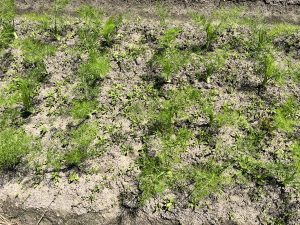
There was a high level of weed pressure in the untreated plot. The main weeds present were common goosefoot and shepherd’s purse.

Stomp Aqua, containing Centium and AZ 500, provided good weed control but caused slight yellowing at the start of the growing season.
This article was written as part of the ‘Belat’ demonstration project run by the Agency for Agriculture and Sea Fisheries.

